Build on Hyperliquid 2026: Builder Codes, HIP-3, HyperEVM
Build on Hyperliquid: earn builder-code fees on every trade through your app from 100 USDC, deploy HIP-3 markets, use CoreWriter. October 2026 guide.

Work through Build on Hyperliquid 2026 with me
- 1Fund a builder account · 10 min
- 2Ship a simple interface first · 5 min
- 3Grow volume through it · 5 min
- 4Explore HIP-3 and HyperEVM for bigger builds · 5 min
- 5Get help to ship · 5 min
Hedge it, right here
Farm the volume, not the direction.
Each card opens a short hedge flow here. The venue opens beside the steps, and funding and fees still apply.
The full guideRead the full write-upEvery step, fact and link
Build on Hyperliquid 2026: Builder Codes, HIP-3, HyperEVM
The biggest opportunity on Hyperliquid today is not waiting for another airdrop. It is getting paid on every trade someone else makes. Hyperliquid pays builders directly and permanently through on-chain fees. If you have an audience, an idea, or the ability to ship a simple interface, Hyperliquid can be a revenue stream.
As of October 2026: no second Hyperliquid airdrop is announced (about 38.888% of HYPE is reserved for future community rewards, with no schedule), while builder codes and HIP-3 markets are live and paying builders now.
What is Hyperliquid?
Hyperliquid is a high-performance perpetuals exchange running on its own Layer 1, with HyperEVM as its smart-contract layer. Its November 2024 HYPE airdrop (about 31% of supply) set the standard for a self-funded, community-first perp DEX. The team's stated vision is bigger than an exchange: to be the "AWS of liquidity", an open base layer other apps build on. Three pieces make that real.
How do Hyperliquid builder codes work?
Hyperliquid builder codes pay an app developer a fee on every trade executed through their interface. When a user trades through your app, the order carries your builder code and you earn a percentage of the trade value. It is automatic, on-chain and permanent.
The barrier is low: becoming a builder requires 100 USDC in your Hyperliquid perps account. Ship a front-end, a bot, a Telegram trading tool, or anything that routes orders to Hyperliquid, and your users' trades can pay you. Get set up on Hyperliquid.
My take: "Farmers wait for a drop. Builders get paid on every trade, every day, with or without one."
What are HIP-3 and CoreWriter?
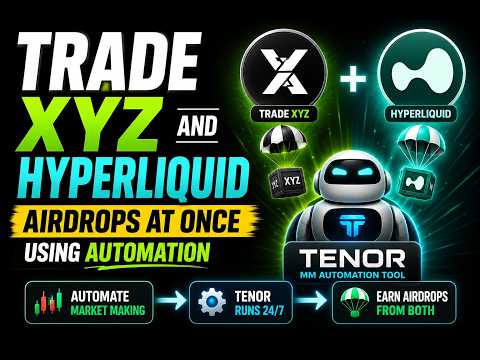
HIP-3 lets builders deploy their own perpetual markets permissionlessly, and CoreWriter lets HyperEVM smart contracts write directly to HyperCore, Hyperliquid's exchange. HIP-3 is already carrying real products: Trade XYZ runs tokenized-stock, gold and silver markets on it, and deposits land in your Hyperliquid account first. CoreWriter means any dapp on HyperEVM can execute trades on Hyperliquid's core exchange. Together they turn Hyperliquid from a place you trade into a platform you build on.
How to start building on Hyperliquid (step by step)
Build it: a Telegram bot that opens delta-neutral pairs between Hyperliquid and another venue, with your builder code on every Hyperliquid leg. Farmers get a tool; you get a fee on their volume. Our own airdropSEA Play game routes real perp volume the same way.
What does it cost, and what are the risks?
Building on Hyperliquid starts at 100 USDC plus your time, and builder-code revenue is real on-chain income, not a token promise. The risks: smart-contract risk, the responsibility of handling user orders correctly, and market risk if you trade your own capital. Use only official Hyperliquid domains and never share a seed phrase , per how to avoid airdrop scams .
Hyperliquid builder FAQ
What are Hyperliquid builder codes?
An on-chain mechanism that pays app developers a fee on trades routed through their interface.
How much does it cost to become a Hyperliquid builder?
100 USDC in your Hyperliquid perps account.
What is HIP-3?
Permissionless builder-deployed perpetuals: builders launch their own perp markets on Hyperliquid. Trade XYZ is a live example.
Is there a second Hyperliquid airdrop?
Not announced as of October 2026. Build for builder-code revenue now and treat any future drop as upside.
Does building on Hyperliquid count toward a future airdrop?
Nobody knows how a future reward would be measured. A shipped app with real volume is the strongest footprint you can hold, and it pays fees in the meantime.
Related: Hyperliquid ecosystem farm , the Hyperliquid entry , Developer airdrops and grants , Build on Bankr , and the airdrops list .
Hyperliquid is the rare protocol that pays you to build on it. Ship a simple tool, attach your builder code, and grow it with a crew.
Research, not financial advice. Web3 carries risk, do your own diligence.
Developer airdrops reward builders. Ship a real app and contract with Deployr, or cross over to ceoism, evolve into a founder, and go after grants and VC funding. Can't build it yourself? Deployr can build it for you.
More field notes
New to web3, or want the bigger picture beyond airdrops? Explore web3wikis - how it works, why it matters, and what you can do with it.
Research, not financial advice.