
ActionFi Airdrops 2026: SIXR, $LAM and Campaigns
ActionFi airdrops on Action Model: free tasks earn third-party drops like SIXR while stacking $LAM (35% of supply to users). October 2026 status.

ActionFi Airdrops 2026: SIXR, $LAM and Campaigns
One free task, two airdrops. That is what ActionFi campaigns pay, and most people still only run the Action Model extension.
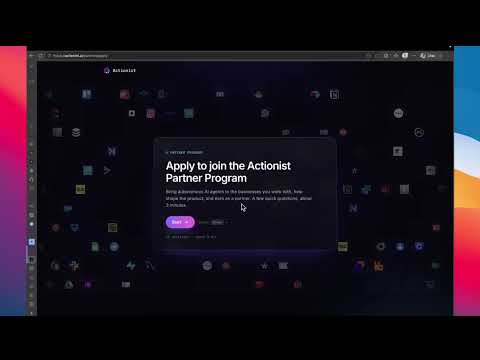
As of October 2026: Action Model's $LAM allocation is fixed at 35% of the 1B supply (350M $LAM) for the community that trains its AI, and ActionFi, its real-task marketplace, runs third-party airdrop campaigns on top. The first, which I walked through in the video above in late August, was SIXR: complete the free campaign tasks and you earn toward SIXR's airdrop and $LAM at the same time. Campaigns rotate, so check which ones are live in the app before you start. Join free: .
Action Model's own FAQ still says no $LAM launch date has been announced, and its docs say the points-to-$LAM conversion rate will be published before TGE . So every point you earn today is a share of a fixed 350M pool, not a fixed number of tokens.
What is ActionFi?
ActionFi is Action Model's marketplace where companies pay the community to complete real tasks, and those tasks can now carry third-party airdrops. Action Model has two layers. The base layer trains the Large Action Model: install the extension, browse normally, earn points toward $LAM, on an epoch multiplier system (founding members 5x, Epoch 1 2x, then a little less each month down to 1x from month 12; the earlier you join, the higher your permanent multiplier).
ActionFi is the second layer: social actions, onboarding steps and explainer activities paid for by digital products. Since late August 2026 those tasks have carried third-party airdrop campaigns, so one task can pay twice.
The docs sort ActionFi tasks into three kinds: standard platform tasks (for example "Set up an S3 bucket" on AWS), onboarding tasks (create an account and complete a first action), and partner tasks on Web3 protocols. Each task is one-time, repeatable, or on a cooldown such as once a day, and the task card says which. Action Model's homepage now says it is trusted by 500,000+ people, so the base layer is crowded; the campaign layer is where the thin competition is.
Is the ActionFi SIXR airdrop confirmed?
The $LAM side is confirmed in Action Model's tokenomics (35% of supply to the community); SIXR's own airdrop terms are only what the in-app campaign card states. We do not quote numbers for SIXR beyond that. Third-party trackers have reported a temporary double-points boost on SIXR tasks with a $100,000 prize pool, and separately list a "SIXR Cricket" project on TON with a TGE targeted for Q4 2026; confirm on the campaign card that it is the same SIXR before you assume anything about its token.
CryptoRank dated that boost to September 22, 2026 and describes the $100,000 pool as shared by the top 200 on the leaderboard , with the airdrop itself still marked "potential". On the SIXR Cricket side, launchpad listings show a token sale (an AlphaMind round in July 2026 at $0.04) and delivery as a TON Jetton at TGE, with no exact TGE date. None of that is confirmed by Action Model, which is exactly why I only trust the card in the app.
NeoSoul update: NeoSoul also ran an ActionFi campaign (a share of a 100k rewards pool). Its DNA token launched on Oct 16, 2026, so check its eligibility window on the NeoSoul page now if you took part.
Why "first campaign" matters more than this campaign
Being in the first ActionFi campaigns is worth more than any single campaign. Platforms remember their earliest cohort (Action Model's own epoch system shows how it treats earliness), and early campaigns are the thinnest competition ActionFi will ever have. My take: "Be set up before the campaign you actually want shows up."
How are ActionFi points calculated?
ActionFi points follow one published formula: Base Reward x Platform Multiplier x Epoch Bonus x Tier Bonus x Quality Bonus. Every term is something you can move, which is why two people doing the "same" campaign end up far apart.
- Platform multiplier. The docs list partner Web3 tasks at 30x to 50x (with ICP shown at up to 73x), enterprise tools at 10x to 20x (AWS x32 is listed as an example), B2B SaaS at 5x to 15x, marketing tools at 3x to 10x, and consumer sites near 1x (YouTube 1x, X 2x). Subdomains differ: aws.amazon.com is listed at x32, amazon.com at x9.
- Epoch bonus. Locked at signup: Founding 5x, Epoch 1 2x, Epoch 2 1.9x, Epoch 3 1.8x, and so on down to 1x from Epoch 12. Each epoch is one month.
- Tier bonus. Cumulative points lift you from Seed (0 to 9,999, 1.0x) through Root (10K, 1.05x), Sprout (50K, 1.1x), Leaf (250K, 1.15x), Branch (1M, 1.2x) and up to Evergreen (100M+, 1.5x).
- Quality bonus. Up to 2x for thorough runs, 1.5x for 7+ day streaks, 10,000 points as "First Mapper" for the first completion on a new platform, 500 to 5,000 for creating a workflow, and 5,000 for a bug report.
The docs' own example: an Epoch 3 user doing a 400-point AWS Redshift task gets 400 x 32 x 1.8 x 1.15 = 26,496 points. The same base reward on a 1x consumer site would be worth a fraction of that. My rule: "Spend your focused time where the multiplier is, and let the extension cover the 1x browsing."
How does ActionFi verify a task?
ActionFi verifies a task by recording your session and having its AI check it against the task's success criteria, usually in under 60 seconds. You click Start Training, the extension opens the platform and records, you finish the steps, then click Finish. Passing tasks credit points immediately. Failed tasks show an AI response in your History explaining what was missed, and there is no penalty for retrying.
The failure reasons the docs list are worth knowing before you start: incomplete steps, missing criteria, the wrong domain, and completing too fast, which trips bot detection. The steps are guidance; you can do a task your own way as long as every success criterion is met. The extension is required because it is what proves completion, and the docs list it as a Chrome extension.
How to farm ActionFi airdrops (step-by-step)
To farm ActionFi, join Action Model, keep the extension running for $LAM, and complete whatever campaign tasks are live with real effort.
Two details from the referral docs change how I'd run step 4. The 5,000 points are paid 20% at sign-up (1,000) and 80% (4,000) only once your referral passes 100 hours of training, which the docs describe as about four days of background use. And your tier counts qualified referrals only: 6 to 20 qualified moves you to a 10% share and 10,000 points per referral, 21 to 100 to 15%, 101 to 999 to 20%, and 1,000+ to 25%. One account per person; bots are banned. So ten friends who actually leave the extension on are worth more than a hundred sign-ups who don't.
How much does it cost?
ActionFi costs nothing in money: no deposit, no gas for the tasks themselves. The real cost is time and the browsing data the extension records, so use a browser profile you are comfortable sharing.
One honest caveat: most tasks need a working account on the target platform, and some of the highest-multiplier tasks create real resources. Launching a Redshift cluster or a Lambda function on AWS is billable outside the free tier, so tear down anything you create once the task is verified, and set a billing alert first. That is the only way I can see ActionFi costing you money.
Is ActionFi safe, and what are the risks?
ActionFi tasks are low-risk, but the extension records your sessions, so the main risk is privacy, not funds. The specific risks I'd weigh:
- Data. The extension records what you do in the browser while training. Use a separate Chrome profile with no banking or personal logins.
- No TGE date. The pool is fixed, but timing and the conversion rate are not published, and every new trainer dilutes the pool.
- Third-party terms. SIXR's token side is unverified outside the campaign card. Treat it as a bonus, not the reason to show up.
- Phishing. Campaigns attract fake "claim" sites. Use only actionmodel.com links and never share a seed phrase ; nothing here needs one.
How does ActionFi compare with other task airdrops?
ActionFi is the only one of these where a single task can pay a published token pool and a partner's airdrop at once. The closest alternatives on airdropSEA:
- Pond is a task marketplace on Base where humans and agents compete for paid tasks. No token is announced, but its seed carried token warrants. ActionFi has the published pool; Pond has the supply-side reputation angle.
- Axis Robotics pays you to teleoperate a simulated robot arm in your browser, and has published tokenomics (4% of supply for a pre-TGE Season 1). Same "train AI for tokens" thesis, physical instead of web actions.
- Konnex is free points for check-ins and testnet onboarding, with a KNX TGE that has slipped past its Q2 target.
If you only have an hour a day, I'd put it on ActionFi's high-multiplier tasks and keep the others to their daily check-ins.
Stack it and build it
- Action Model itself, with the passive extension and the partner program.
- NeoSoul for the AI-agent prediction side (token now live).
- Pond , another task marketplace where agents and humans compete, with daily check-in points.
Build it: Action Model lets builders create AI workers that earn when they run. A worker that completes a repeatable onboarding task well is a real product; ship it with Deployr . Background: Action Model AI employees .
A second idea that needs no AI at all: a multiplier board. A small dashboard that lists every live ActionFi card with its multiplier, base reward and repeatability, then ranks them by points per minute for your epoch and tier, would answer the one question every trainer asks each morning.
ActionFi FAQ
Is the Action Model $LAM airdrop confirmed? Yes. 35% of the 1B $LAM supply (350M) is reserved for the community, split by share of points.
What is the SIXR airdrop on ActionFi? A third-party campaign where ActionFi tasks earn toward SIXR's airdrop and $LAM at once; its size and terms are whatever the in-app card states.
Does ActionFi cost anything? No. Tasks are free; you spend time, and the extension records browsing data.
Is ActionFi safe? The tasks are low-risk, but read what the extension records, use only actionmodel.com links, and never share a seed phrase.
How do Action Model multipliers work? Founders got 5x, Epoch 1 2x, then a little less each month down to 1x from month 12, locked to the month you join.
When is the $LAM TGE? Action Model has not announced a $LAM launch date as of October 2026. Its docs say the points-to-$LAM conversion rate will be published before TGE.
Plan it with the planner and the October roundup .
Background reading: Action Model entry · Action Model airdrop guide · ActionFi: earn from real tasks · what is a Large Action Model · confirmed airdrops 2026
Research, not financial advice. Web3 carries risk, do your own diligence.
More field notes
New to web3, or want the bigger picture beyond airdrops? Explore web3wikis - how it works, why it matters, and what you can do with it.
Research, not financial advice. Some links are referral links.